Saturday, November 23, 2024

Read It Yourself


The revised version of the project this blog was all about is published and available in print or ebook from Amazon at this link: Playing Pirates by Heather E Dumas

#ad (I do make affiliate money if you buy using this link. But I get money anyway from royalties, since I wrote it.)

Saturday, April 20, 2013

The Finished Product


It's very satisfying to see my master's thesis in hardcover. Also not too shabby was getting my department's Excellence in Research award for this project. 


Thursday, April 11, 2013

See My Magazine Feature Story...

The spring 2013 edition of Perspectives Magazine has a story about my thesis research on page 6. This is the one that I was interviewed for last fall. Having spent a number of years in journalism myself, I was a little nervous about what the end result might be, in that doctors-make-bad-patients kind of way. But I'm rather pleased with how it turned out. And the reporter, photographer, and editor were all wonderful to work with. Click the link, go...look on page 6. Enjoy! 


Officially Official

It's officially official--my thesis is done! The final copy has been accepted by the graduate college and everything has the green light for graduation in a couple weeks. Now all I have to do is teach and grade papers for the rest of the semester.

It's been a wild ride. I'd been to renfaires before, and I enjoy them or I would never have attempted this project. But just as with anything in life, when you start examining the minutia of something in a new way, it takes on whole new meanings. And of course, whenever you run something through a slew of social theory it always comes out sounding both impressively complex and ultimately simple at the same time...at least for me. 

No spoilers on the findings in the final paper. However, as per my university's policy, it did get uploaded to OhioLINK and should show up on a Google search by some time later this year. (I still get a weird feeling in my belly every time I think about that, like my butterflies aren't sure if they're going to be sick.)

No pirates were harmed during this research project...although a few did ask to be flogged later, because they like it. 

Monday, April 1, 2013

Thesis Defense

My thesis defense was this afternoon, and I passed. There are still a few minor tweaks that the paper needs to be perfect. But the important thing is that I survived the process. And no, it was not the torturous grilling over red hot coals that so many people have described to me. There were a few tough questions, but that's the point. It's been nice to work with a committee--and especially the professor who has been my committee chair--who want me to succeed at this. Now, to fix those bits that still need seeing to before the end of the week so I can get this turned in and graduate on time. 

No pirates were harmed in the defense of this thesis paper. (And you thought there was no way to mention pirates in this post.) 

Monday, March 11, 2013

First Draft

The first draft of my thesis is finished and has been sent off to my committee chair for her feedback. In the meantime, I've been working with the draft I have, formatting it to the university's standards. Who knew APA 5 was going to become valuable again? There will be edits to make before the final copy is ready for reading, I'm certain.

 It's coming down to the time when things are going to get serious with deadlines, oral defense, and graduation looming on the horizon. About time.

Sunday, February 3, 2013

Nerd Heritage

In case any of my adoring fans (or professors who might be stalking me online to see how this project is progressing *waves hello*) were wondering, I'm into the intensive writing phase of this project now. Today's highlight is that I have successfully and cleverly used the phrase "nerd heritage" in a sociological paper, related to the expression of a connection to or identifying with various fandoms and minutia of popular culture (ex. Browncoats, Trekkies, Whovians). This is a proud day for geekdom, or at least a small moment of amusement for me. The thesis-ing process continues. I have set myself the deadline to have a first "real" draft in the hands of my advisor by the first of March (or there about). Right now there's only about 31 pages (mostly lit review)--not pretty ones either--excluding the four pages of bibliography (which probably need to be cleaned up too). But it's a work in progress; this is the final stretch and I can see where things are going.

Saturday, December 22, 2012

Worst Apocalypse Ever


Considering that we've all seen several--dozens even--"end of the world/planet/civilization" scenarios in the movies/TV/literature/church all of our lives, I would have to agree with these fellows (these grumpy geezers are a hoot). But we wouldn't be encountering all these hypothetical ways life as we know it would all come crashing down if it weren't for some larger, for a "culture of doom" if you will.

Let's take this latest doomsday myth, for example. The real descendants of the ancient Maya were back in the old country yesterday celebrating the end of one cycle and the beginning of the new. It was, by all accounts (from Western news media, which is the best I could find on it, unfortunately), more like our New Years Eve celebrations, full of remembrance and hope at the same time. Meanwhile, back in the USA everyone is going on about the "Apocalypse" like the planet is going to explode. Even the intelligent people who know it's not true, because they have found no empirical evidence (that means science) to back it up, are still making jokes and posting memes on social media about the “world ending.” Because that’s the meaning our culture has attached the end of the Mayan calendar cycle, that the planet has to explode, get hit by a meteor, get taken over by some plague that turns all humans into flesh-eating zombies, or else Jesus swoops down on his angelic-white horse to call up all his followers (they know who they are, but somehow the rest of us are none the wiser despite hearing about this all our lives) so that the rest of us can happily slay one another out of despair for not having been caught up in the original “rapture.”

Exactly. Those are our myths; those are the stories we tell one another, our kids, our friends’ kids when their parents aren’t looking (so that the little’uns will freak out later when it’s bedtime and we can have a good laugh when the friends post on social media that their son or daughter wouldn’t sleep all night, thus neither did the parents, because they were convinced Jesus was going to send zombies to blow up the Earth or some such rot). You know how it goes. We hear stories about “primitive cultures” who had stories about the bunyip, or the sasquatch, or that gingers who died without being baptized would reanimate their corpses in order to drink the blood of their living tribesmen. And then we say something about how it was “just a story to scare their children in order to keep them from misbehaving.” Just like we tell children in our society that they better be nice instead of naughty so that Santa Clause will bring them toys and mittens instead of sticks and coal for [fill in name of winter festival of your choice here]. It lasts until somewhere between the age of 6 and 10 when they figure out it’s just the adults in their life, else why would Santa be “operating on a tight budget this year” or “leaving those gifts in the top of the hall closet for safe keeping.” (The really adventurous one may even sneak downstairs and catch Gramps red handed putting gifts under the tree, a little schnockered on the eggnog, like I did in the second grade.)

Myths are usually not “real,” but they have some kernel of “truth” in them. There is some kind of value (well-behaved, obedient children) or meaning (we’re all afraid to die!) embedded in the story, but the emotional triggers in the tale help it stick in our memory in a way that we internalize the values and meanings written between the lines.

Yes, okay, we all generally get that…after four years of college and a lot of late night reading or watching documentaries as a means to educate ourselves. And in that process we are also exposed to new myths, new memes and tropes and cultural patterns from popular media (meaning movies, TV, books, viral internet videos, and social media which is in its most basic sense the means by which the populace spreads information).

So then why this pervasive notion that the world was going to end on the winter solstice in the year 2012? No, not because it was the end of the grand cycle on the Mayan calendar. When our calendar runs out we simply flip the page or hang a new one in the kitchen. We don’t assume the planet will explode because the cycle ends and we, literally and figuratively, turn another page. It's no more of a zombie apocalypse than waking up the next day with a raging hangover after drinking too much and kissing someone completely inappropriate before passing out at 3 a.m. and waking up at noon. What’s so mythic about that outside the stories people will tell later about the “epic” party? Nothing, aside from us, as a society, even choosing to mark time in years and planetary orbits at all because our brains like patterns and we’re smart enough to notice things like seasons and the fact that about once a cycle it snows on us in many parts of the world. I can see where back in the day before gas furnaces and twinkly electric lights that whole winter thing could be frightening—the possibility of starvation and hypothermia always is. But that, as they say, is not really the end of the world, even if several individuals are no longer in it.

With a lot of time on my hands (and a small bit of mental fatigue flavored avoidance that is keeping me from writing on my thesis in the past little bit), I have thought about what it is that made everyone freak out, to some degree or another, about this impending world-ending, society-leveling doom.

Why did we all buy into this 2012 hype? Because Jesus told us to! (Before you get offended, read on, please.) No matter what religious tradition—or not—one considers themselves to be affiliated with, everyone in the Western world, and most of the rest of it as well, has heard variations on the same apocalyptic stories from one or more of the prevailing world-spanning mainstream religions of Middle Eastern origin. That’s a short, politically correct way of saying you’ve all heard the Christian stories of how the world is supposed to end and most people end up in eternal torment—meaning it won’t be fun. We live in a culture with a long-standing tradition of anticipating an “apocalypse.” Under every good thing is the realization that this too shall eventually end. No mater how badass your civilization, it has to end sometime. Just ask the Romans. Oh wait, you can’t because about 1,500 years ago, give or take a couple decades, their whole business went down the flusher too. And what took its place? Religion. The Christian religion, which in most parts of Europe (admit it, that is the basis of our cultural heritage here in America) was the social glue holding things together, often the only thing preventing (or causing, lest we forget he Inquisition and Crusades) mass chaos and panic. Popular (meaning of the general people) myths were something everyone shared knowledge of, and thus usually internalized the values and meanings thereof, to one degree or another. Let's face it, it's a good way good to communicate with others because they too know what you're talking about. Things like “be good or you’ll go to hell,” or “be good or the bogie man will eat you,” or perhaps “be good or Santa will leave a lump of coal in your stocking.” (And we all hate rocks in our socks.)

Sound familiar? Our civilization has grown up on tales of world-ending doom. “Jesus is coming back any day, so don’t screw up.” Whether or not someone believes that to be literal truth is not at issue here. But the idea that we, as a society, as a people with a long cultural heritage spanning hundreds of years, have this tradition that one day some cataclysmic event is going to end it all, is something we have been collectively cultivating for a long, long time. Is it any wonder that when capitalist profiteering and high-tech visual media is thrown into the mix, everything we see and hear is full of this same theme when a few people latch onto an old (and, as usual, misunderstood) bit of lore from a culture that seems foreign enough from our own to be scary, everyone takes our cultural tradition of the ever-imminent “apocalypse” and runs to the extreme with it? Remember all the hype over Y2K? Exactly like that.

And what does this have to do with “pirates and princesses” or the Renaissance? Almost nothing. Except that it was since the European Renaissance that science has presumably taken over from myth (we can lump religion, folklore, and magic together for our purposes here) as the pervasive mode of thinking and examining the world in our society. Yet, some 500 years later, here we are, happily freaking out, wondering if perhaps—despite all evidence to the contrary—a meteor might not strike the planet yesterday (12.21.12), unleashing an alien virus that turns everyone into zombies, ending civilization as we know it and causing mass chaos and panic. And of course, since you're reading this, that did not happen. 

Happy Holidays! And may every apocalypse you experience be just as lame. Cheers! 


Monday, November 12, 2012

Other Somewhat Related Things

The thesis project is still in the transcription and analysis phase. Besides teaching, the thing that has taken most of my attention these past several days has been the task of submitting applications for various and sundry PhD programs so that I may continue my education next year. Deadlines, especially those for funding and assistantships/fellowships are fast approaching. And I set myself the goal of getting things taken care of by the first of December so that I do not encounter the same problem I did when applying for Master's programs--that of running out of money for application fees until after initial deadlines. What a mess and bunch of unneeded stress that was!

So this is me checking in, just in case anyone is keeping tabs on the blog. The exciting part of this project (at least for readers) is over, for a while anyway.

Monday, October 22, 2012

The End of One Phase and the Beginning of Another


This year's renaissance festival season here in this part of the Midwest has come to a close, and along with it the data collection portion of my thesis project. I have had an incredible amount of fun and learned a great deal--about my research subjects, myself as a researcher, and how this whole process works. I have collected a notebook and a half full of field notes and many, many hours of recorded interviews. The photographs alone could be used for more than one entirely separate content analysis project as well.

Now comes the long tedious winter of transcription, analysis, and writing. It is my intention to have a completed draft of this paper by March, if not sooner. My biggest problem now is to make myself sit down and continue to work on this project instead of staring another. However, once older weather sets in that may not be as much of a temptation. I may be happy to be able to sit at home and write instead of braving the elements!

I got a lot of encouragement from my professors, my friends, and even those rennies with whom I spoke about my project. And it seemed like so many conversations produced new ideas for potential future studies that I could write about this for years to come. I certainly feel like I have enough data to sift through for a while...

I'm sad to see this part of things end, but excited to finally see the finished product (and get my degree!) when this is completed. There will be updates posted to this blog still as things happen, or as fun insights might emerge from the data that seem appropriate to share. So don't lose the link.

Sunday, October 14, 2012

Birthday Loot and the End of Data Collection

First, I can announce that he data collection portion of my thesis project is officially concluded. Not that I ever really stop gathering information, but I'm done in the strictest sense. I have hours and hours of recorded interviews to transcribe, and about a book and a half of various field notes and personal musings about the project to go through. And the lit review is sort of almost to a rough draft. So that's another step along the path...

Also, it was my birthday last week. And rennies have a tradition of pinning money--as a birthday gift--on the clothing of the birthday person. My observation over the years is that this cash is then often spent on alcohol, but that is a generalization and by no means expected.

I got a lot of "Happy Birthday"s from random people who recognized the money pinned to my shirt as a renfaire birthday tradition. The guys I was there with, who are relatively new to faire (or at least not truly immersed in the subculture) asked about both the money and how people it was my birthday. To which I gave the same explanation. So this is me with birthday loot pinned to my blouse. I didn't go very far in funding my research, but it was enough to pay for my lunch.

Monday, September 10, 2012

Making the Rounds

This is my sixth season attending renaissance festivals, my fourth consecutive at this particular faire, and I have watched a pattern emerge in the way people greet one another. Rennies hug. But it's more than that, there is a kind of almost ritual involved in the hugging.

When a person or the small group they traveled to faire with first arrives on site, after the typical dash to the privies (that means the restroom for those unfamiliar with medieval lingo), there begins an almost systematic lap of the faire site so that one can greet--and hug--each and every person they know who is either working there or is visiting for the day. In cases where the individual in question knows a great many people at the faire this can actually take a couple of hours.

Rennies hug, as I've stated before. But it's not only those who are close friends as happens in the rest of the world. If someone has met you before they will hug you upon greeting them, more so if they find you remotely attractive, funny, or otherwise in any way pleasant. Sometimes they might even hug one another upon first meeting, for many of the same reasons, or as a means of flirting or to try to build a friendship. Flirting is a huge part of social interaction at the renfaire, but that is for another post.

And something else interesting about the hug-greetings is that many rennies don't even have to remember your name to feel that hugging is appropriate. There is a man who works at one of the shops with a young lady whom I know rather well. He has greeted me with hugs several times and I cannot for the life of me remember his name, nor he mine I'm sure. But he always comments on my red hair and how much he adores redheads.

Sidenote: Rennies also adore redheads. And I have noticed a markedly higher proportion of gingers to other hair colours at faire over the years, compared to the general American population even.

Back to hugs. After the initial rounds of greetings and hugs, one is then free to go about their day of seeing shows, shopping, and general play among the people who are there for the same purpose. Often one goes back to spend some time with close friends, although if those friends happen to be working at one of the shops or booths the interaction is sometimes intermittent while the shopkeeper assists customers. I have seen (and been part of) multiple interactions in which the shopkeeper's visiting friend helps them make a sale.

And it is also interesting to note that because so many rennies work at any given faire, the visits during which playtron friends, or sometimes even others who are working at a faire they live local to and are driving there for the day or weekend only, quite often friend pairs or small groups may have only one or very few lengthy conversations or meaningful interactions during a given faire season. But still they hug one another like family each time they meet.

This process of making the rounds to say good-bye to friends and acquaintances is customarily done at the end of the day or whenever one is planning on leaving. This can be shortened to simply stopping in, hugging, and giving a quick "gotta go" before sprinting off to the next person to say good-bye to. And the list of people to hug on the way out may also be kept to only those close friends, or sometimes only those one must pass on the way to the gate to leave. However, if it is a person's last day at that faire for that season--hugs all around! Everyone that person knows must be visited. Again, this can take up to a couple of hours depending on how many people one knows.

In this kind of fantasy environment where the senses and emotions are both beset with highly charged input, friendships can feel as if they happen quickly, and social bonds form at a pace not usually seen in mundane life, perhaps because of the fleeting nature of the social context and the short length of a given faire season (usually only 4-8 weekends a year depending on the festival). While neither this nor the flirting that is such a significant part of social interaction at renaissance festivals are the topic of my thesis, they are still incredibly interesting and will probably be the subject of some future paper.

Thursday, September 6, 2012

Isaac Had Other Plans

By Isaac I mean the hurricane, or the rain that resulted by the time that weather pattern had migrated into the Midwest. This past weekend there was a forecast for rain, and since my data is stored in either electronic devices that dislike getting wet or in a field book which holds similar opinions, I kept an eye on the atmospheric prognosis.

I awoke at 7 a.m. Saturday with every intention to head off to the ren faire, weather permitting. I checked the hourly forecast and found the prediction for somewhere between 60 and 100 percent chance of rain in the area of the faire site. I made other plans for the day. A similar scene followed Sunday morning.

This being Labor Day weekend, the only time the faire is open other than Sat. and Sun., I decided to hit the road and deal with whatever weather I met. I ended up getting rather soaked, thankful that I had left book, recorder, and camera in the car safe and dry (which is why there are no pirate pictures for you this week). The day consisted mostly of greeting those participants I had not seen since last season, and discussing with some of them my thesis project, deciding who would be top priority as interview candidates on subsequent weekends.

I did have a good chat today with my committee chair which led to an idea about attempting a small demographic count. It's not the emphasis of my project, but it is relevant. We'll see if that pans out later. But in the meantime, on the road again this weekend.

Thursday, August 30, 2012

And So It Begins...Again

The fall semester has begun here at OU, and there have been about a half dozen students request to add my Intro to Sociology course despite the class being full. Well, the classroom is not full, just the registration capacity. This afternoon's office hours have involved a lot of add slips for students.

This weekend begins the annual season for the next renaissance faire I'll be attending for my thesis research. I'm hoping to get some good information, but I anticipate (based on my previous experience with this particular faire) that I may have gotten my really good, personal insight kind of data earlier this summer. However, I hope I will be pleasantly surprised and get some more awesome data. I like data, is that nerdy of me?

I have still to get all of my pirate garb and other gear packed for the weekend. There's a check list I go through to make sure I have everything. (Are my boots still in the back of my car? I think so.) I'm looking forward to it. This is an incredibly fun research project!

Tuesday, August 7, 2012

The Calm Between Storms

I can't exactly call this break between renaissance faires the doldrums (that's pirate talk for a calm spell when there's no wind, it's usually wicked hot, and your ship gets stuck in one place so long you want to walk the plant to break up the boredom). I've been slowly hacking away at transcribing interviews from the first half of this project, as well as getting a bit of reading done for the literature review portion of the paper. I have gotten through three books in the past three days--it's hardly nothing. However, compared to the constant adventure that it was in June and early July, the sailing has been a bit calmer.

You may notice the photo of me and the other two pirate lasses. That was taken at the Great Lakes Medieval Faire in northern Ohio. We spent the day there--my first time at this particular faire--and then stayed the night at the home of the parents of the teensie one you see in the middle there. (I was standing on a step, she's not that short.) Her dad cooked, her mom and sister stayed up and drank rum with us. It was a great time. That's a playground pirate ship we commandeered (nautical term), but only momentarily. The younger skalliwags soon demanded their ship back.

The day at GLMF wasn't one of official research for me, more a basis of comparison for the other faires in this project. The site itself is lovely, all woods and twisty paths. But there was not the same level of interaction that I feel like I got spoiled with at the Kentucky faire. Still, it was a nice break, even though the drive made it too far away except with overnight accommodations.

I have three weeks until the next renfaire I'll be attending, but of course classes start back here the week before. I'll be teaching through the week and in the field on the weekends again. At least this next faire is closer to home (2 1/2 hours instead of 4 1/5 away).

Wednesday, July 11, 2012

A Brief Note

This week is extremely busy. It's marks not only the end of the season for my first faire site for this thesis project, but also the last week for the intro to sociology class I'm teaching as well. This being the first time I've had to create and grade final exams, and grade term papers, and figure and post final grades for the course...I want to get it right.

But I also felt it would be remiss of me to ignore this blog for an entire week, especially since I got so much good data, made many new contacts, and was treated so wonderfully at the Kentucky Highland Renaissance Festival. There will be updates as I process the information I have collected--once I have more time to give it the thorough attention it deserves. Until then...

Friday, July 6, 2012

Hot, Hot, Hot

I'm talking about the weather. Anyone who has stepped outside their air conditioned lair anywhere in the continental U.S. is aware of the heat these past couple weeks, so I won't bore you with a list of heat index numbers. However, just as extreme rain does not deter rennies, neither does extreme heat. At least not much.

The cast, boothies, and performers at this faire continued on through the scorching heat last weekend, and intend to do so again tomorrow for what marks the closing weekend for this festival. Certainly there were slight changes and accommodations made to cope with the heat. Sleeves were rolled up and boots exchanged for sandals. Everyone took up the cause of making sure everyone else was drinking plenty of water. And shows like the joust--where men and horses alike could easily get overheated from all that gear and activity in the blazing sun--were cut shorter. None of the patrons seemed to mind. In fact, there were somewhat fewer patrons who came out to brave the heat this past weekend. But then, they may have all saved up their faire days for the previous Steampunk Weekend when there was record attendance.

For some, this is a hobby, something fun to do on a day off from work, a chance to escape the hum-drum of daily life and step into a fantasy for a day. For others, it is a life they perhaps wish they could live more often, though renfaire seasons in their part of the country last only a few weeks or months of the year. (Many of them spend the rest of the year looking for similar activities that can in some way transport them back into the fantasy, whether it be gaming, cosplay, or other such things.) And for those who travel the renfaire circuit, this is more than a livelihood; it is a way of life. I applaud the fortitude of everyone who helps build this temporary realm that comes to life inside the festival gates.

Tuesday, June 26, 2012

Clockwork Faeries, Tudor Roses, and Science

I must find a way to sleep...sometime between all of the driving, and interviewing, and note taking...and teaching when I'm back in the real world. But so far (possibly because I have managed to keep the Barge, meaning my car, on the road despite sleep deprivation) it has been worth it. I had an excellent time this weekend and got some really great interviews with some renfaire pros whom I feel privileged to have gotten to talk with so candidly.

Nyxie Tryx the Thistle Faerie
had fun with the theme of
Steampunk Weekend.
To start at the beginning, this was Steampunk Weekend at the faire. What is steampunk and what on Earth does it have to do with the renaissance, much less 14th century Scotland, you may ask. Steampunk is a geek fantasy version of Victorian science fiction. Think H.G. Wells and The Time Machine and you'll be on the right track. Or, as I've heard it said, steampunk is what happens when goths discover the color brown. In any case, there isn't really much that it has to do with 14th century Scotland, but both renfaires and scteampunk tend to appeal to the same subculture audience of consumers and event attendees. And that more than anything is what they have in common--geeks who like to dress up and spend money. I mean, let's be honest, as fun and affirming as it is, these festivals are still a business. And this past Saturday there was a record number of people through the gate, certainly the most so far this season. Steampunk is popular. Perhaps one in five people in attendance was in some kind of clockwork, Victorian, or fanciful high-low-tech costume or accessory. And it seems to be that almost anything looks steampunk if you add goggles. Even the Faewood Faeries.


The Tudor Rose Players
The Tudor Rose Players, an independent historical acting troupe who started in renaissance faires, were guest cast this weekend. We took some time early in the day Sunday for a panel interview of sorts in which I got to talk with five of them at once about what they do and how they help to create the unique fantasy and authenticity of experience that is the renaissance festival. Their reputation for striving for historical accuracy preceded them, and I was not disappointed. These people are scholars as well as performers. And, as a textile geek (and kilt-o-phile), I especially loved the aside lesson on the history of the kilt with their artistic director. Also, I got some good insider information on the more intense experience of working some of the larger faires. Oh the plans I have for when I get to do more extensive research than this thesis! (PhD dissertation, anyone?)

Doktor KABOOM!
And, saving the best for last, I had a "lunch meeting" with Doktor Kaboom on Sunday. He is becoming a bit of a celebrity in certain circles, not just renaissance faires, and so it was a privilege to be able to monopolize a little of his time. This man has been performing at renaissance festivals (although not as the Herr Doktor) for many, many years. He had some wonderful insights to share about the subculture behind the scenes, not just while the faires are open. He is smart, funny, and he knows renfaires. Certainly one of my best interviews so far. Plus, this man is promoting science, and there's just something enjoyable about listening to a grown man speak intelligently about how he gets to play like a little kid. "The best part is--I'm at work right now!" Me too, sir. Still the best thesis topic ever.

Wednesday, June 20, 2012

Hats, Roles, Carnival, and Masquerade Weekend at the Faire

This was Masquerade Weekend at the faire. Many of the cast members, vendors, and even some of the patrons wore masks or dressed in costumes that were not their usual mode of dress. And it illustrates quite well one of the major points from my own theoretical framing, that of the carnivalesque setting and the way norms are purposefully inverted in such a context.


What did she just say? Okay, here's one example: I would normally dress as a pirate at renfaire. You've all seen the pictures in previous posts. But this weekend I pulled out a couple of dresses from my days (of yore) in the SCA that, in the context of this particular faire count as "noble" garb. Meaning I dressed as a "Lady" instead of a pirate. That's a big change in roles, and a huge leap in status, even if you considered the *ahem* captain character, as the owner of a ship and an entrepreneur, not to be a lowly criminal. Huge reversal, no? That's what I'm talking about. I was even treated differently, as part of the play of course, the cast all know what I'm doing with my research and my persona. Many of them curtsied /bowed to me and called me m'lady who would not have done so were I wearing a pirate hat instead of a circlet and veil. 


But it was not only me. This picture of the cast at pub sing Sunday afternoon also illustrates this point. Look at the hats. Some of them have traded with others of vastly different stations. The two you can see here are the king's piper (in front waving her arms) wearing the tinker's hat, and (behind her in yellow) Lady Isobel wearing the cooper's hat that looks like one of his barrels. Though they were not taking up one another's trades for the day, there was still the inversion of "norms" by the trading of hats that scholars have written about in a carnival or festival setting, especially when dealing with things of the medieval time period. It's really validating when something like this in my research comes together without even trying or looking for it.


Tuesday, June 19, 2012

Rain or Shine

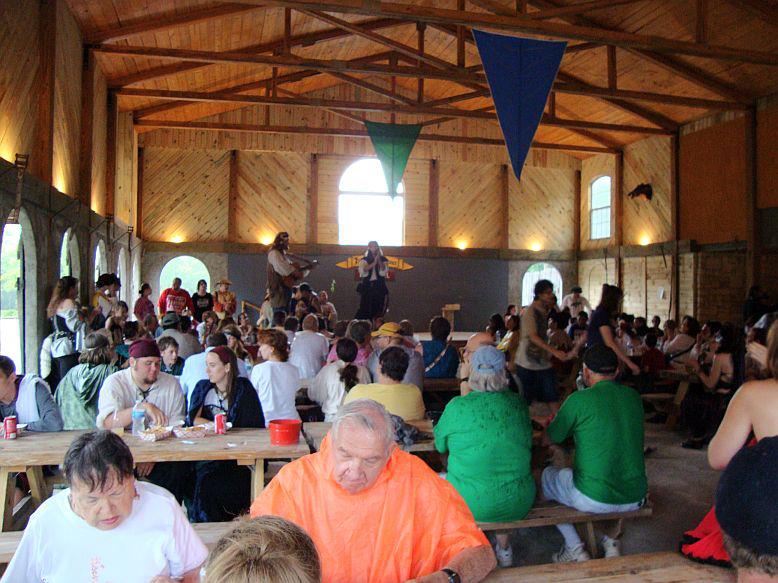
This weekend's research theme ended up being somewhat about adjusting to adverse situations--in this case some very rainy weather. This was the scene outside the doors to the main pub on site at the faire. It started raining at around 9:00 Saturday morning, with the gates not opening until 10:00. But even so, many die-hard festival goers traveled from near and far to attend.

I have learned that nothing can dampen a rennie's spirits for long, not even a deluge from above. While it was raining buckets (Kentucky colloquialism) outside, there was a party going on indoors. Nearly 200 people gathered in the pub for singing and performances by several of the acts that do not show up there during the course of a typical day. And this was even before the bar opened! Aside from the usual musicians, like Drunk & Sailor here seen here in the photo, the Dueling Fools stopped in for a brief display of their cutting wit and swordplay. And the jousting troupe put on a sword fight in the main isle. Meanwhile, patrons and cast alike enjoyed food and conversation. It was rather like the whole faire in miniature. And people kept filing in even through the rain.

The weather finally cleared up at around 1:00. There were still puddles of water to avoid and wet stages to contend with, but the festival continued as planned after that.

The particular challenges I faced as a research involved the logistics of taking notes with all that water falling from the sky. I usually carry my field book tied to my belt. (At the renfaire, everything you carry hangs from various straps on your belt--money pouch, drinking mug, fan for the hot weather. It's easier than trying to carry a separate tote bag or satchel that you might lose.) So, no sh** there I was (that's an SCA joke), trying to conceal my phone behind my hair/veil in order to record audio notes to myself. Luckily, Sunday's weather was more accommodating, at least earlier in the day, and I was able to carry my book with me like normal.